
Underground chambers, ducts and pipes (especially those less than 600 mm below ground level) may be affected by tree roots. The risk will depend on the ability of the apparatus, in particular any joints, to resist or tolerate distortion.
Direct damage
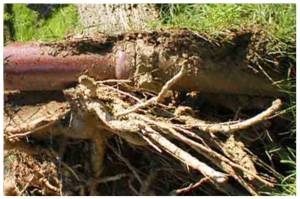
Direct damage is caused by the annual increase in root thickness resulting in eventual contact with apparatus. However, it is usually the root or the adjacent soil that will distort rather than the apparatus itself. The potential for damage depends on the potential for the roots to thicken. Lateral roots thicken over successive years, eventually becoming the large woody roots of the structural root system of a mature tree. These lateral roots taper rapidly and at a distance of 2.0 -3.0 m from the stem base they are usually only 2.0 -5.0 cm in diameter, by which stage they have lost much of their rigidity and physical strength.
Indirect damage
Indirect damage only occurs on shrinkable soils, mainly clays but also peat and some silts. Such soils shrink as they dry out creating the potential to distort any apparatus supported by the soil. Trees growing in the immediate area may exacerbate the drying effect.
The degree of the shrinkability of the soil will affect the amount of movement caused by drying and thus the potential for damage to occur. In situations where apparatus passes from a shrinkable soil into a rigid soil structure there is the possibility of extreme distortion taking place. Regular seasonal movement can also cause damage even in the absence of roots, particularly with short segmented pipes.
Root incursion
Intact apparatus will not generally be penetrated by roots. However roots can exploit existing defects such as defective joints, cracks and degraded pointing of inspection chambers.
Where internal conditions are moist and aerated and therefore most conducive to root growth, root proliferation may occur and ultimately block the apparatus. If root thickening occurs where it passes into apparatus, root related enlargement of a defect may occur.
Trees and Wind Movement
The potential for damage to apparatus close to a tree may increase due to movement of the stem and a structural root system as the tree sways in strong winds. Such movement may result in direct pressure being applied to the apparatus.
Reference: National Joint Utilities Group: Guidelines For The Planning, Installation And Maintenance Of Utility Apparatus In Proximity To Trees, Volume 4 Issue 2