
The following article is written by Andrew Stewart, who is currently studying the Spanish dehesa for his PhD.
In May last year, deep in the wood-pasture south of Toledo, I found it was all true – the Iberian dehesa (day-AY-sa) and montado (in Portugal) really is as biodiverse as I had read. Nightingale and warbler song surrounded me, turtle doves and cuckoos called. Like something from a rainforest, a golden oriole’s plangent notes bounded around, while frogs squawked remarkably like startled jays. A deer looked up, then sprang away. At twenty-five I stopped counting the plants at my feet, distracted by dragonflies, bees and midges zooming by. Neck bells clanked as sheep grazed somewhere behind me. Warm drifts of dung swirled about. I had stepped into an unending, multi-lingual conversation, an almost overwhelming experience, heartbreaking for its absence in Britain. And somewhere out there, lynx prowled, while eagles, storks and vultures patrolled the skies. This sensory overload was repeated wherever I stopped.
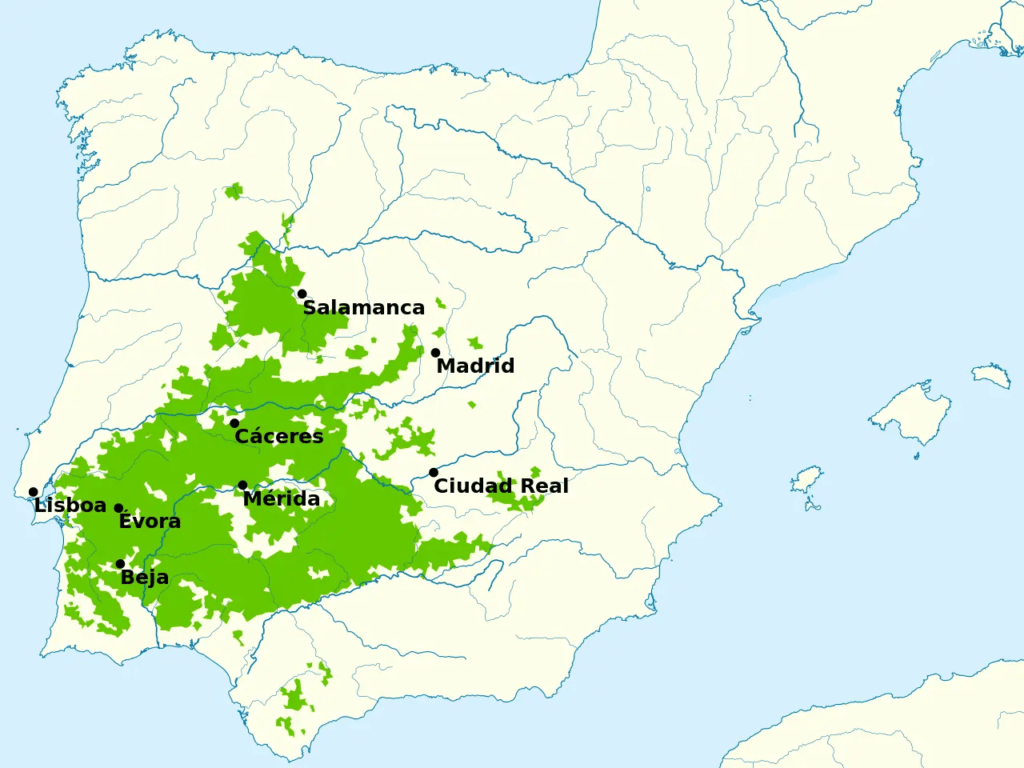
Map of Iberian Peninsula showing the dehesa of Spain and montado of Portugal.
The southern edge of the main green area runs long the northern bank of the Guadalquivir River. This is where the land rises up to the Sierra Morena.
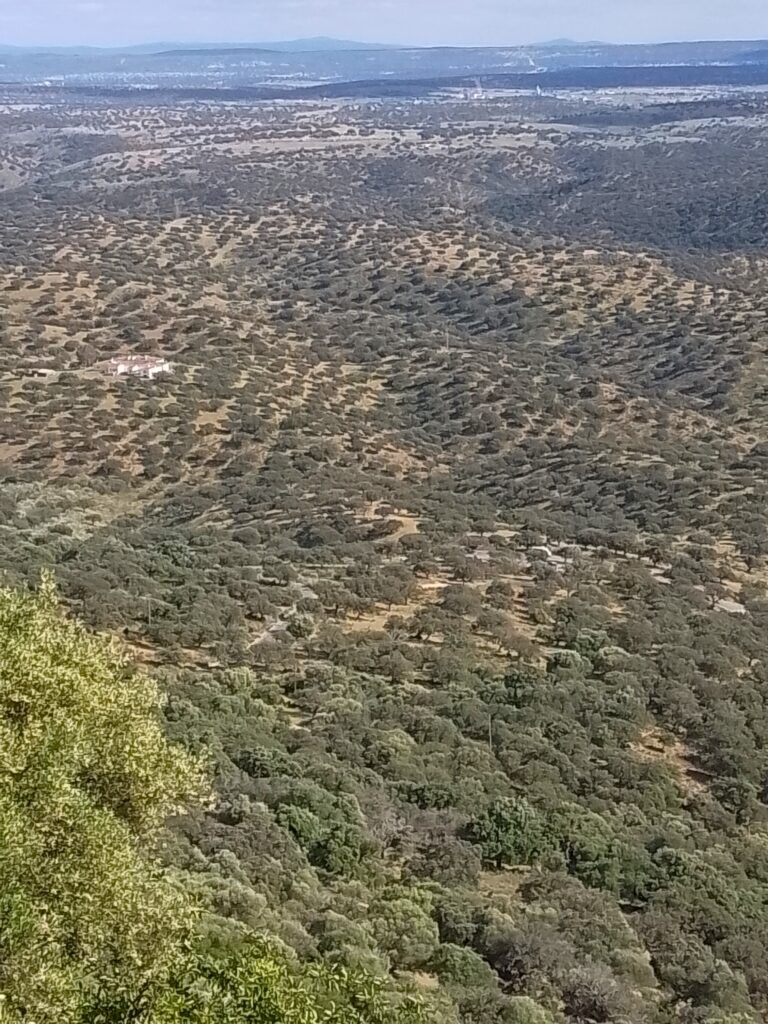
View of dehesa looking south-west from Monfragüe Castle, Extremadura.
The apparent homogeneity of the view belies a heterogeneity of localised habitats. Humans and livestock may be impeded by walls and fences, but birds and other inhabitants have uninterrupted freedom to roam, unlike their cousins in the devastated agricultural lands of the UK where habitats such as woodlands are few and far between
Wood-pasture agroforestry means scattered trees dotting varied grasslands, creating a biodiverse, multifunctional landscape. In the dehesa, evolved over thousands of years, the trees are mainly holm and cork oaks, the livestock are pigs, sheep, goats and cattle. It forms the largest wood-pasture landscape in Europe – 5 million hectares, well over a third the size of England. These are the bare facts, but they belie the profound human-nature intimacy.
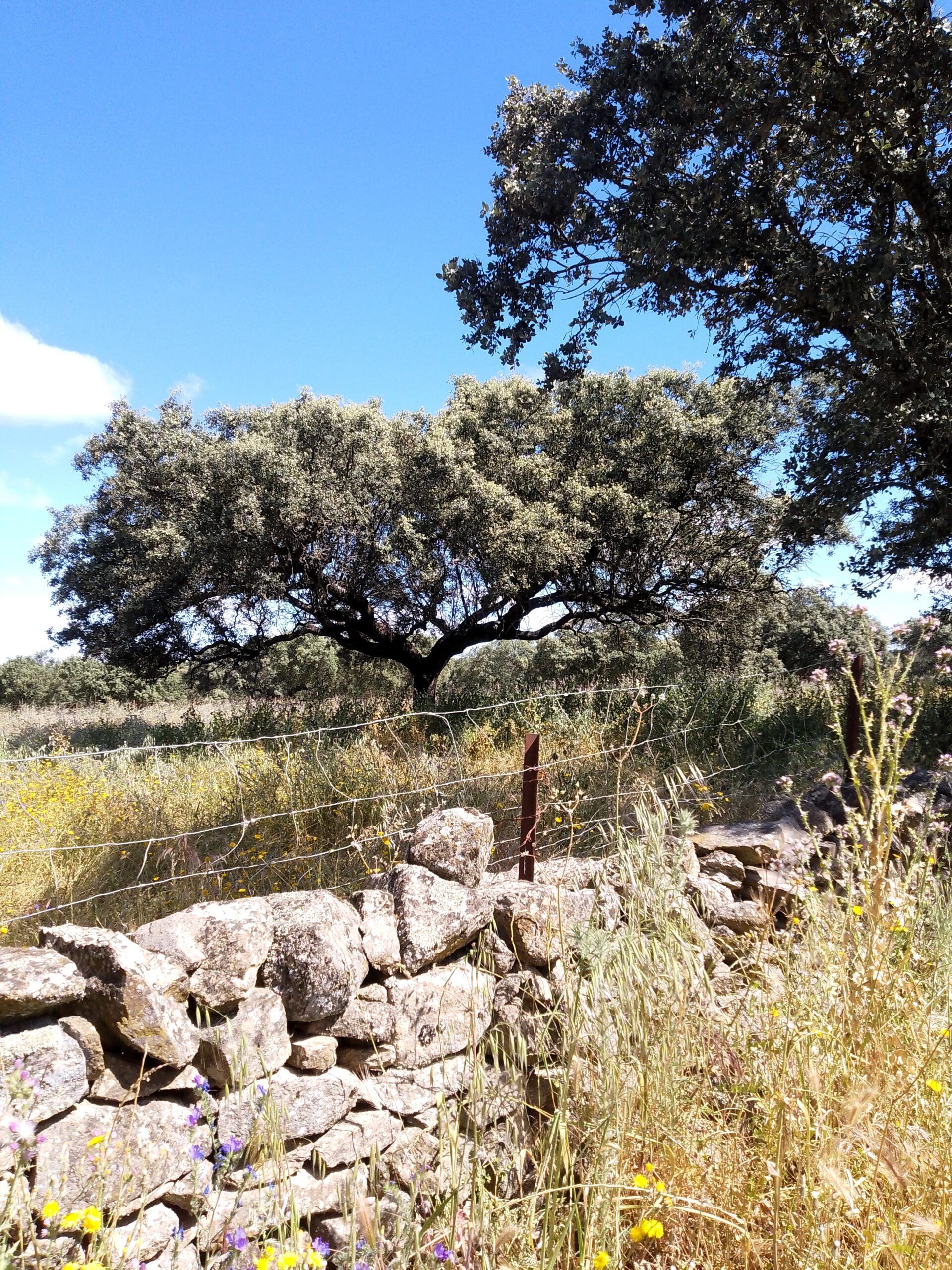
Take the oaks. They are pruned to create the characteristic copa shape, more broad than tall. Greater space lets roots and crowns spread, making them healthier and more resilient than their crowded forest brethren. Rather than being simplistically causal – humans as manager-controllers – is it in fact more accurate to see the relationship as emerging from centuries of experiential entanglements between humans, trees and landscape, to the ultimate benefit of all?
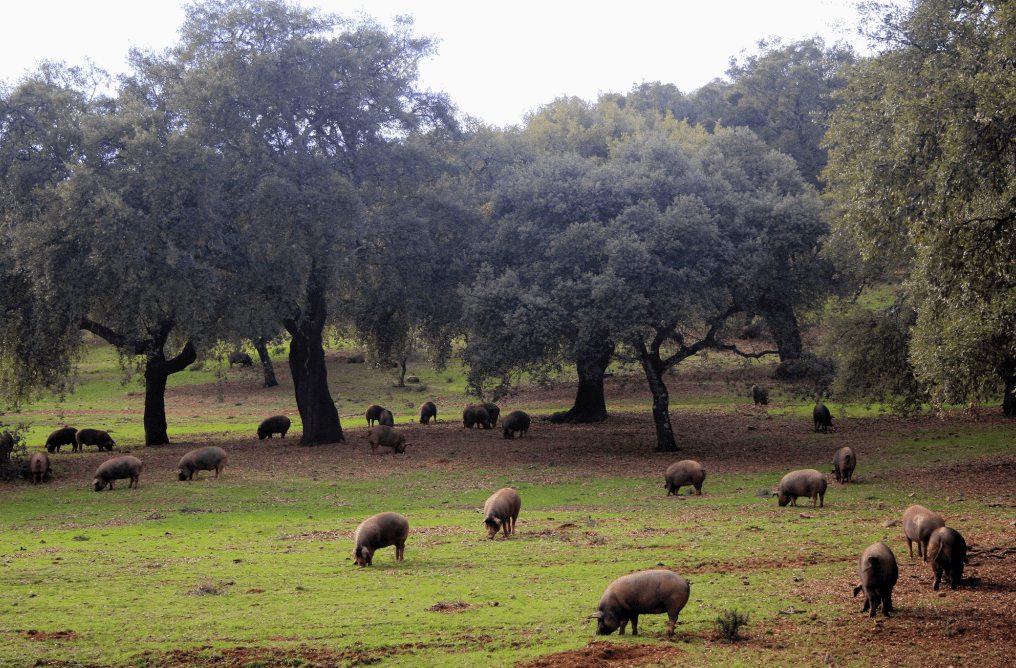
Apart from providing shade, the branches are now reachable so the acorns can be knocked down with long sticks for the pigs to eat, turning their favourite food into the famous Iberian acorn-fed ham, graded and certified like the greatest Bordeaux wines. Complex and aromatic, these hams are rich in microbes so essential to our health. But whilst foraging, the pigs disperse dung, turn the soil, promote germination, disturb insects, which feed the birds and other dehesa creatures. As for the corks, the bark is still used for stoppers, but also, now, by NASA as a sacrificial material (lightweight and heat-resistant) on spaceships.
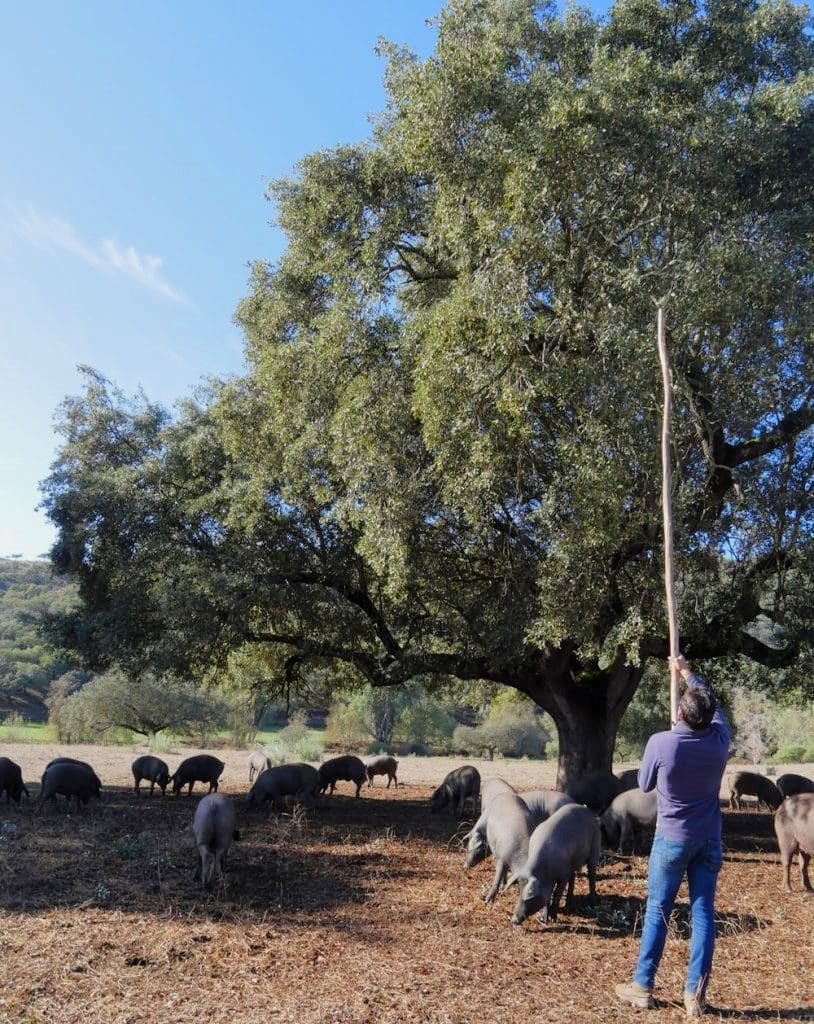
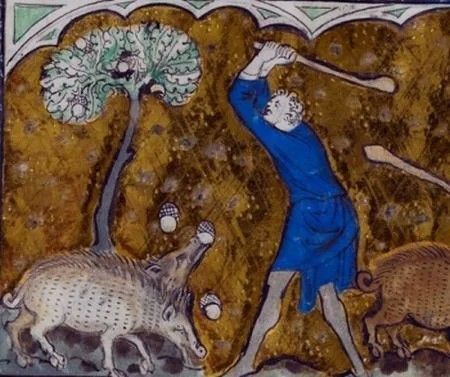
It appears, then, that dehesa’s three main characteristics seem sufficient – they are human-adapted, agriculturally productive and very biodiverse (the herbaceous layer alone rivals rain forests for fecundity). Yet, one more fact lends heft to arguments that humans and nature can co-exist in positive symbiosis, in stark contrast to historical narratives and the mute industrial monocultures that now surround most of us; when abandoned, dehesa biodiversity actually declines.
Like all landscapes, dehesa are under threat – abandonment and intensification, that is, rural depopulation and capitalism’s blind pursuit of profit, meaning, for example, more cattle, not an animal dehesa can cope with in high numbers. It also means shrub encroachment and increased wildfire risk, loss of local knowledge and culture, poorly pruned, fatally-damaged trees, fragmented families – human and non-human. As a rare and diminishing sustainable agricultural system and haven for European wildlife, dehesa have much to teach us if we are open and humble enough to observe and learn.