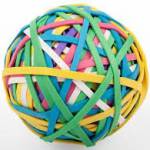
 Rubber is elastic and water-resistant, it floats and doesn’t conduct electricity. As latex it is used to make adhesives, contraceptives and tennis balls for Wimbledon; when vulcanised (nothing to do with Star Trek) it is used to make tyres, wellington boots and artificial hearts.
The Rubber Tree
The rubber tree (Hevea brasiliensis) is native to the rain forest of Brazil.
The sap or latex from the rubber tree is harvested by tapping the trunk and collecting in bowls.
The Story of Rubber
1731: During an expedition to South America, French explorer Charles Marie de La Condamine (1701-1774) sends back samples of rubber to Europe, prompting intense scientific interest.
1770: The English scientist Joseph Priestley (1733-1804), who discovered oxygen, finds he can use pieces of rubber to erase the marks made by pencil on paper. In England, erasers are still widely called ‘rubbers’ today.
1791: Englishman Samuel Peal develops a method of waterproofing cloth with a rubber solution.
1818: Scottish medical student James Syme (1799-1870) uses rubber-coated cloth to make raincoats.
1823: Englishman Charles Macintosh learns of Syme’s discovery, refines it and patents it, earning fame and fortune as the inventor of the rubberized, waterproof coat. Waterproof coats have been known as Macintoshes ever since. Here you can see Harold Wilson, British Prime Minister, famous for his Mac. 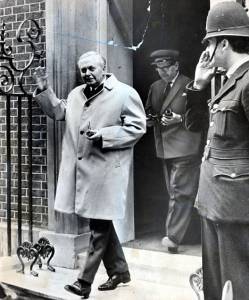
1839: American inventor Charles Goodyear (1800-1860) accidentally discovers how to vulcanize rubber after dropping a piece of the material (which had been treated with sulfur) onto a hot stove.
1876: Englishman, Henry Wickham, collected 70,000 seeds from Brazil and shipped them to England where some 2,800 of the seeds germinated and were sent to Colombo in Sri Lanka.
1895: Henry Ridley, head of Singapore’s botanical garden, persuaded two coffee growers to plant 0.8 hectares of Rubber trees. Twelve years later more than 300,000 hectares of rubber grew in plantations in throughout Sri Lanka and Malaya. New innovations increased efficiency, and production doubled every two years. Rubber could be produced at only a fraction of the cost of collecting wild rubber in Brazil.
WWII: The Japanese invasion of South East Asia prompted the Allies to develop synthetic rubber and by 1964 synthetic rubber accounted for 75% of the market.
1973: OPEC oil embargo doubled the price of synthetic rubber and made oil consumers more conscious of their mileage. The radial tyre replaced the simple bias tyres (which had made up 90% of the market only five years earlier) and within a few years virtually all cars were using radials. Synthetic rubber did not have the strength for radials; only natural rubber could provide the required sturdiness.
1993: Natural rubber had recaptured 39% of the market. Today, nearly 50% of all car tyres and 100% of all aircraft tyres are made of natural rubber.