Introduction
The following relates primarily to planting ‘standard’ trees rather than planting ‘forestry whips.’
There are four key elements to the successful establishment of newly planted trees:
- Tree selection
- Tree quality
- Tree planting
- Tree maintenance
Tree Selection
Tree choice is of great importance and there is a lot to think about. No matter the quality of the tree, no matter how well you plant it and no matter how well you look after it, if the initial choice is not properly considered the outcome will always be a disappointment.
The following are some of the factors you need to consider when choosing your tree:
- native, naturalized or introduced species
- origin and provenance
- broadleaf or conifer
- deciduous or evergreen
- small, medium or large ultimate height
- upright or spreading habit
- acid or alkaline soil
- exposed or sheltered position
- coastal or inland location
- free draining or wetland site
- low, medium or high-water demand
- potential stem diameter
- existing hard landscaping / boundary walls
- adequate space for root and crown development
- above and below ground services
The list will make the difference between a tree dying, a tree surviving and a tree thriving; the difference between a tree being an asset and a tree being a liability.
Tree Quality
Without exception, healthy landscape trees are derived from high quality nursery stock. Ensuring high quality trees are available for planting is essential if successful establishment is to take place.
The following are some of the attributes of a good quality tree to look out for:
- A tree should have between 4 and 11 primary structural roots. These can be checked by pushing away the soil surface to examine the structural system.
- The structural root system should be furnished with an even distribution of fibrous roots. The fibrous roots should not be matted, kinked, or girdled.
- The tree (if container grown and staked) should remain upright in the container when the support is removed
- The trunk should have a single stem, a single leader, a gradual taper, and an appropriate diameter for the height of the tree

- The clear stem should not exceed one third of the overall height of the tree
- The bark should be intact. the size, shape, colour and density of leaves are great indicators of the vitality of a tree and should meet expectations
- Branches should be well spaced with good distribution both radially around and vertically up the trunk
- Branch diameter should be no more than two thirds the diameter of the trunk
- Avoid tree with forked junctions
- The canopy should be free of dead or broken branches
- There should not be any stubs or flush cuts due to formative pruning
- The crown should be symmetrical
- Roots, trunk, leaves and branches should be free of pests, diseases and disorders
Tree Planting
Planting a tree is like cooking a rare steak or a soft-boiled egg, it is simple but not easy, and it is surprising how often it not done very well.
Good practice for planting should include:
- Trees should normally be planted during the dormant season
- Trees should be supplied in suitable packaging
- Tree pits should be at least twice the diameter of the root spread, and the same depth of the roots of the stock to be planted
- The bottom and sides of the tree pit should be forked to break up the subsoil
- Excavated subsoil should be removed from the site and should be replaced with topsoil, planting compost or other suitable growing medium
- Staking may be required on sites where there is a risk of mechanical damage, vandalism, or from windy conditions
- Abrasion should be avoided by using a buffer of rubber or plastics between the tree and the stake
- Tree stake height should not exceed more than one third of the overall height of the tree

- Trees must be planted at the original root collar soil depth; the root flare must be visible
- Any broken or damaged roots should be cut back to sound growth
- Coiled roots should be eased from the root ball or cut
- Bare roots should be spread evenly in the planting pit
- The planting pit should be filled gently but firmly. Fill the pit about one-third full and gently but firmly pack the soil around the base of the root ball. Repeat twice more.
Tree Maintenance
Having selected the right tree of the right quality and planted it at the right time in the right manner, the final part of the equation is looking after the tree.
The maintenance for the first two years should include:
- A minimum space of 1m diameter around each plant should be maintained weed free
- Weeding should be carried out by manually, chemically or by mulching. Herbicides (if used) must be applied strictly in accordance with the manufacturer’s instructions and the Food and Environment Protection Act 1985.
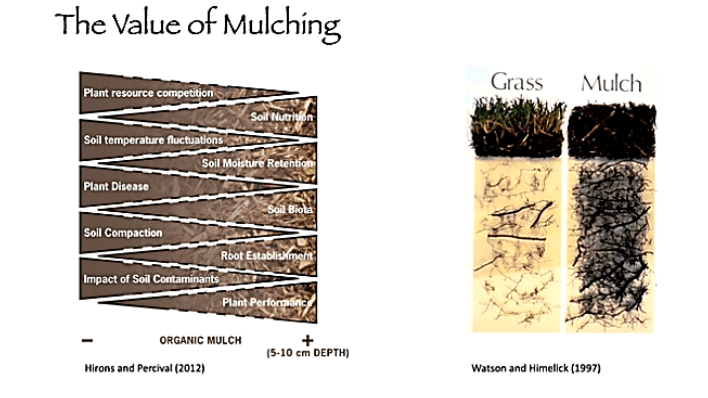
- Mulches should consist of either sheet material or organic material
- Organic mulches should be a minimum of 50mm in depth and a maximum of 100mm in depth. Mulches should only be applied to the root system. Tree stems should be mulch free.
- During the growing season newly planted trees should be watered to ensure that the soil is kept constantly moist
- Water should be applied using a watering can with a rose attachment or a sprinkler or other such method that will administer water slowly and at a low pressure, mimicking rainfall
- Water should be applied to the surface of the tree planting pit, evenly distributed over the whole area to encourage even root development
- A newly planted tree should be continuously watered from bud burst in spring to leaf fall in autumn (for deciduous trees)
- During the height of summer, water should be applied at a rate of 20 litres (roughly 2 x 2-gallon buckets) every other day. A lesser volume water is generally required during spring and autumn.
- Newly planted trees still need watering, even after it has been raining!
- Ties should be checked after gale force winds and at least once a year and should be adjusted or replaced as required to allow for root and stem growth
- Ties should either a) be removed at the beginning of the second growing season or b) reduced in height above ground level by 50% at the beginning of the second growing, reduced by a further 50% at the beginning of the third growing season and removed at the beginning of the fourth growing season
The Success of Tree Establishment
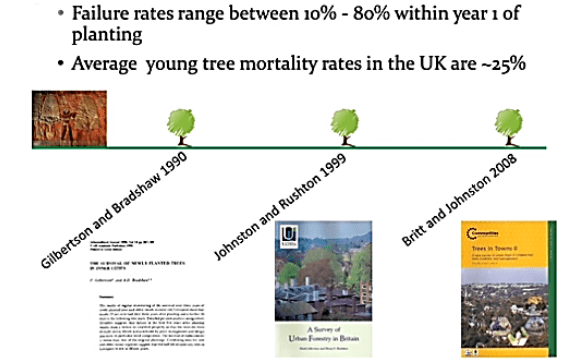
Research carried out by Gilbertson and Bradshaw in 1990, Johnston and Rushton in 1999, and Britt and Johnston in 2008 all found that the average rate of successful tree establishment was around 75%, in other words approximate 25% of all newly planted trees failed within the first 12 months post planting.
The chances of successful tree establishment are greatly enhanced by applying the key elements. However, 100% establishment is unlikely because of elements beyond our control including:
- Environmental factors such snow, frost, drying winds, salt-laden winds (in coastal areas) and hot sun
- Pests and diseases
- Human error such as trees planted too deep or not deep enough, tree stems damaged by mowers and strimmer’s
- Vandalism
Descriptive images from Applied Tree Biology Lecture 5 – Tree Establishment presented by Dr Andrew Hirons