
On a hot summer’s day, what could be better than sitting in the garden in the shade of your favourite tree, drinking a nice cup of tea or an ice cold beer? The obstruction of direct sunlight by trees can be a blessing when it provides a cool, shady area but it can also be a nuisance when it blocks the natural light to the main rooms in the house.
Five Advantages of Shade
- The combination of shading, wind speed and turbulence reduction and evapo-transpiration can reduce the energy required for cooling a building in summer and for heating a building in winter. Trees can reduce peak demand for electricity by 11% and reduce average annual electric use by 3%.
- Drivers will pay a premium to use a tree lined parking area; the additional revenue can off-set the cost of lost parking spaces.
- McPherson and Simpson reported that shade from trees can significantly increase the useful life of construction materials that are degraded by direct sunlight and heat.
- Cooling and shading reduces the incidence of heat stroke and other heat-related health problems; over 2,000 excess deaths are estimated for England and Wales during the heat wave in 2003 (Johnson et al., 2005).
- Studies in Greater Manchester showed differences in maximum surface temperature of around 12°C between the open built environment and wooded areas on a hot summer’s day (Gill et al., 2007, p. 122).

Lime and Sycamore
Most lime trees and all sycamores are prone to sap sucking aphids. Honeydew is a sugar-rich sticky liquid, secreted by aphids and some scale insects as they feed on plant sap. When the aphids mouth parts penetrate the leaves, the sugary liquid, under high-pressure, is forced through and out of the insect’s terminal opening. Sooty mould is a fungus that grows on honeydew and produces dark, fine, soot-like or powdery deposits on the surface of the object on which it is growing, such as your car!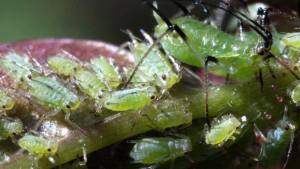
Tree Surgery and Mass Damping
One of the most common reasons for ‘crown thinning’ a tree is to allow more light to pass through. Crown thinning is the removal of a portion of smaller/tertiary branches, usually at the outer crown, to produce a uniform density of foliage around an evenly spaced branch structure. It is usually confined to broad-leaved species. Crown thinning does not alter the overall size or shape of the tree. Material should be removed systematically throughout the tree, should not exceed the stated percentage and not more than 10% overall.
Recent studies have indicated that the morphology of a tree and the dynamic interaction of branches can influence the damping response in winds. Branches on trees act as coupled masses and in winds they develop a mass damping effect which helps distribute, reduce and dissipate the wind energy.
Trees are optimised structures. Crown thinning allows very little additional light to pass through the crown and reduces the mass damping effect, thus increasing the likelihood of branches failing in high winds. 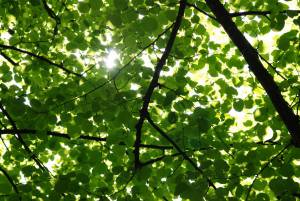
Shady Trees


References:
Site Layout Planning for Daylight and Sunlight by Paul J Littlefair, BR 209.
Branches and damping on trees in winds K R. James ENSPEC Pty Ltd & N Haritos University of Melbourne.
Mechanical Stability of Trees Under Dynamic Loads by Kenneth R. James, Nicholas Haritos and Peter K. Ades.